
Mounting a TV on Plaster, Drywall or Brick: What Changes in an Older Mount Pleasant Home
Most TV mounting guides assume you have drywall over wood studs, 16 inches apart, and a wall with nothing interesting behind it. Plenty of Mount Pleasant homes are like that. Plenty aren't. Old Village houses have plaster. Townhomes and condos often have metal studs. Fireplaces are brick or stone. Here is what changes with each one, and how I handle it.
First, what kind of wall you have
Knock on it. Drywall sounds hollow between studs and dull on them. Plaster sounds hard and dense everywhere and your knuckles will tell you. Brick and stone are obvious. If the house was built before about 1960, assume plaster until proven otherwise. Old Village is Mount Pleasant's oldest neighborhood, with homes back to 1755, and roughly 1 in 6 homes in town were built before 1980 (Census ACS 2020–2024). On Sullivan's Island about half the homes predate 1980. Those are the houses where I slow down and look before I drill.
A second clue is the age of the building, not just the wall. About 36% of Mount Pleasant's housing units are attached or multifamily, and many townhomes and condos built in the last 25 years use light-gauge metal studs in interior walls. A magnet will find the screws in either kind of stud, but metal studs change what fasteners I use and how heavy a TV I'm willing to hang.
Drywall over wood studs: the easy case
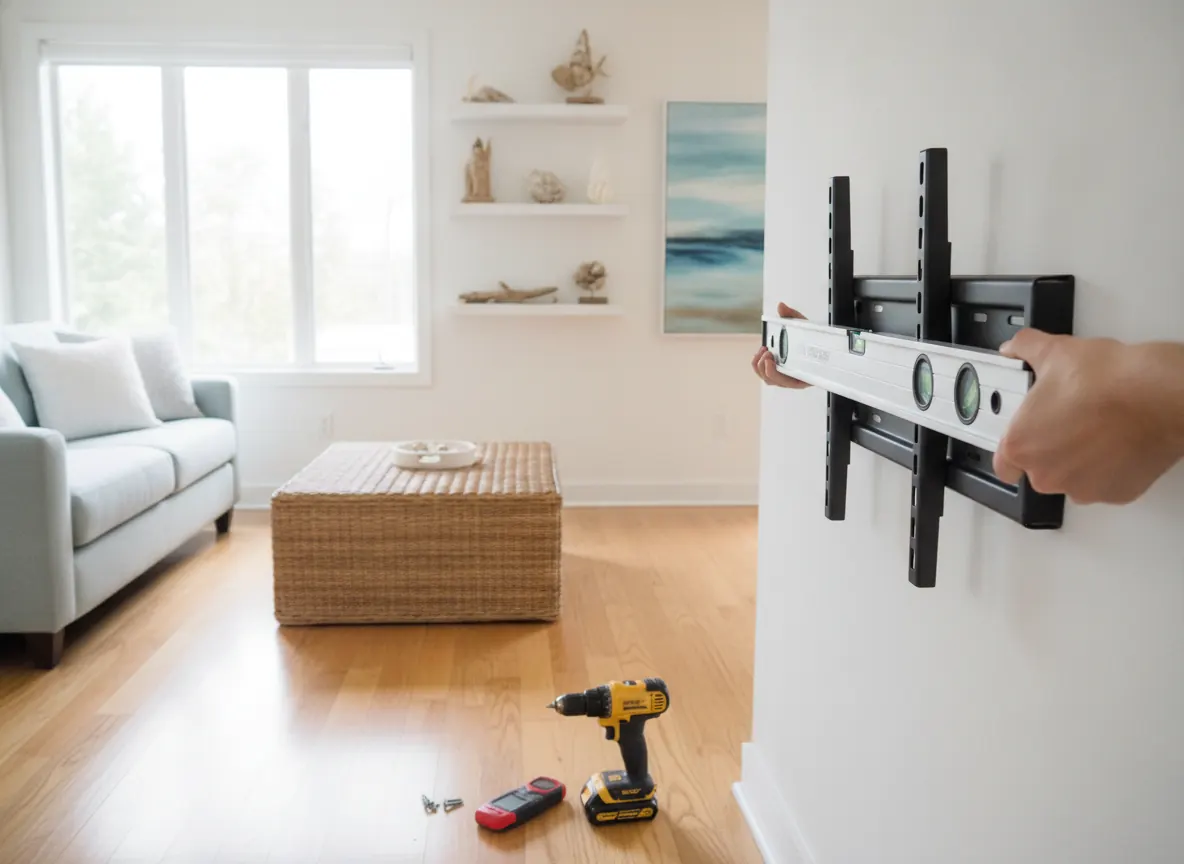
The bracket gets lag-screwed into at least two studs, through the drywall, into solid wood. I find the studs with a finder and confirm with a thin test hole where the bracket will cover it. Done right, a drywall mount holds far more than any TV weighs. The mistakes I see are brackets screwed into drywall alone with the plastic anchors from the box, or a single stud used because the second one was in the wrong place. A fixed or tilting mount can usually be shifted to meet two studs. A full-motion arm sometimes can't, and then I'll tell you what the options are instead of guessing.
If there is already a hole or a failed anchor in the wall from a previous attempt, I'll patch the drywall while I'm there. Small patches are quick when the wall is already open.
No studs where you want the TV
This comes up with corner placements and with walls where the studs are an odd spacing. For a smaller TV on a fixed mount, heavy-duty toggle anchors rated for drywall can work, and I'll tell you the weight limit I'm comfortable with. For a big TV on an articulating arm, no. The leverage on a full-motion mount is what pulls anchors out of walls. In that case the honest fix is a plywood backer screwed to the nearest studs, painted to match, with the bracket mounted to that. It is not invisible, but it is strong, and I'll show you what it would look like first.
Metal studs in townhomes and condos
Metal studs are strong in the direction they are designed for, and weak when a lag screw tries to bite into thin steel. The right fastener is a snap toggle through the stud face, which spreads the load behind the metal. I use them for fixed and tilting mounts and smaller full-motion arms. For a heavy TV on a long arm, I'd again suggest a backer board. If your building has rules about what you can attach to walls, read them before you call me. Renters should also read my post on what you can change in a rental.
Older homesPlaster and lath: slower, not harder
Older plaster is a layer of plaster pushed through wood lath strips nailed to the studs. It is strong, but it cracks when you hammer it, and the plaster "keys" behind the lath can break loose if a drill grabs. So I don't hammer, I don't use a stud finder as my only guide, and I don't trust plastic anchors in plaster at all.
- I locate studs by small test holes along the mount line, behind where the bracket will sit, often confirming with a magnet on the lath nails.
- I pre-drill every hole with a sharp bit at low speed, with tape around the hole to catch chips.
- I use longer screws than the bracket kit supplies, because plaster and lath together are thicker than drywall.
- If the plaster is soft, cracked or pulling away, I'll say so. Mounting onto failing plaster is how you end up with a TV on the floor and a wall to repair.
Plaster takes longer, so the labor is usually at the higher end of the range below. It is still a one-visit job in a sound wall. Old Village and I'On owners, my area page has more on working in older homes.
Brick and stone fireplaces
Masonry holds a TV well if you anchor it correctly. I drill with a masonry bit and use sleeve anchors or concrete screws sized for the bracket. Where to drill matters. Mortar joints are softer and easier to patch later, but crumbly old mortar won't hold. Solid brick holds better but is permanent. On a newer fireplace with a stone veneer, the veneer may be thin over a frame, and I need to know what's behind it before I commit.
Two more things about fireplaces. Heat rises, so a TV directly over a working firebox should sit above the mantel line and ideally on a mount that tilts down, and you should check your TV's operating temperature. And the height over most mantels is higher than the ideal viewing height, which is roughly eye level from the couch. If you'll be craning your neck, consider a pull-down mount or another wall. I'll give you my honest opinion when I see the room.
Wires. I'll run power and HDMI cords through an in-wall rated cord kit where the wall allows it, which keeps the cables out of sight without new electrical work. What I don't do is add outlets or run new circuits. If you want a recessed outlet behind the TV, that is a licensed electrician's job and I'll tell you up front rather than hand it to a buddy. On brick and plaster, cords usually run in a paintable surface raceway instead, because fishing them through the wall isn't practical.
What TV mounting typically costs
| Item | Typical range |
|---|---|
| TV mounting | $120–$250 labor (bracket extra) |
| Drywall patch | $120–$250 small; $275–$800 larger repairs |
| Handyman hourly rate (solo) | $50–$80 per hour |
Typical ranges from published 2025–2026 cost guides (Fixr, Thumbtack, HomeGuide). Estimates, not quotes. I give you a written price before I start.
Plaster, brick and backer-board jobs land toward the top of the range because they take longer. Bring your own bracket or ask me to pick one up; either way the receipt is yours. Full details are on my TV mounting page and the pricing page. Send a photo of the wall and the TV size and I'll tell you what I'd do.
Frequently asked questions
Can a TV mount go on drywall without studs?
For a smaller TV on a fixed mount, heavy-duty toggle anchors rated for drywall can work, and I'll tell you the weight I'm comfortable with. For a large TV or a full-motion arm, no. The safe fix is a painted plywood backer screwed to the nearest studs with the bracket on that.
Can you mount a TV on a plaster wall in an older Mount Pleasant home?
Yes, if the plaster is sound. I find the studs with small test holes behind the bracket, pre-drill at low speed and use longer screws than the kit provides. Plastic anchors don't belong in plaster. If the plaster is soft or pulling away from the lath, I'll tell you before drilling.
Is it safe to mount a TV over a brick fireplace?
The brick will hold it with proper masonry anchors. The questions are heat and height. A TV above a working firebox should sit above the mantel line, ideally on a tilting mount, and you should check its operating temperature. Mantel height is also higher than ideal viewing height, so a pull-down mount or a different wall is sometimes the better answer.
Can you hide the wires when you mount a TV?
On drywall I can run cords through an in-wall rated cord kit, which hides them without new electrical work. I don't add outlets or new circuits; that is a licensed electrician's job and I'll say so up front. On brick and plaster, a paintable surface raceway is usually the practical choice.